Connecting ATT Article 10 to other relevant treaty provisions.

The above visualization sums up the global weapons trade during the Obama era, minus data from 2016. It was created by data scientist Hai Nguyen Mau, and each relationship plots the value of the weapons trade between two countries based on data from SIPRI. It’s important to note that while this data includes major weaponry transfers such as tanks, jets, missiles, and ships, it excludes guns and ammunition or military aid. Lastly, the thickness of each line represents the total value of each trade relationship, while the proximity of two linked countries shows how close each relationship is. (i.e. if a country only imports from Russia, they will be much closer to Russia than the U.S.)
A Longtail Distribution
The global weapons trade is dominated by a few major exporters, such as United States, EU, and Russia:
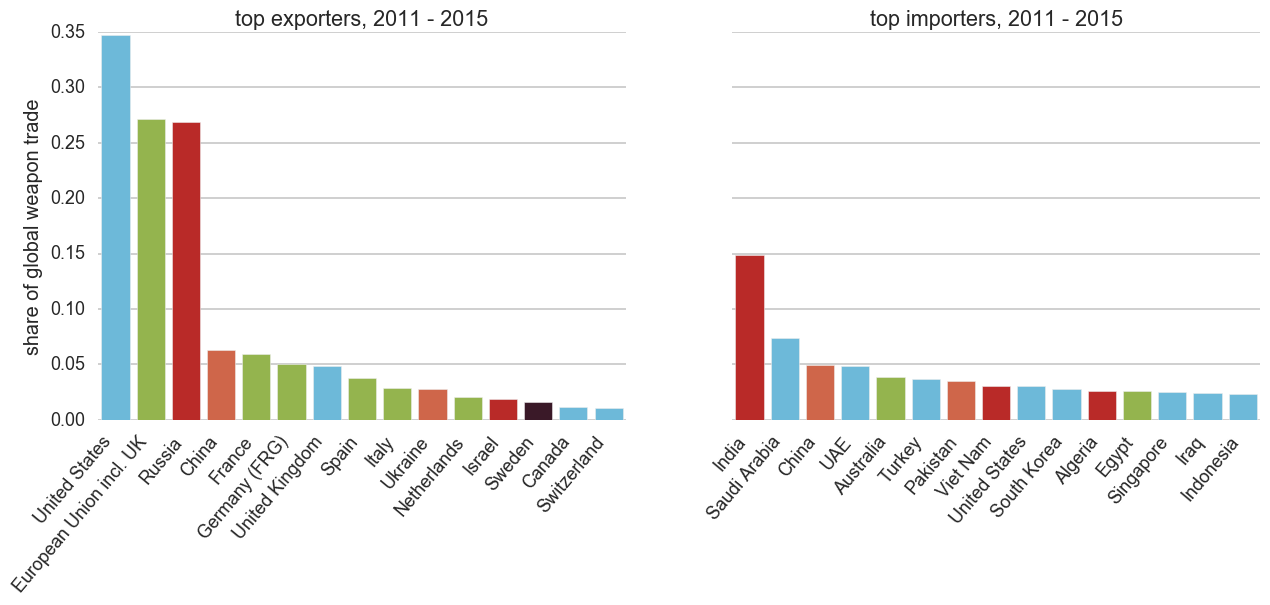
Together, the United States, European Union, and Russia combine for over 80% of weapons exports, while the rest of the world fills out the “longtail” of the exporter distribution. From the perspective of imports, the field is much more equal because almost every country aims to spend at least some money on defense. India is the largest importer of weapons in the world with a 14% share of the market.
Two Distinct Blocs
The picture behind the global weapons trade gets much more interesting as it is broken up into relationships. It’s easy to see that there are two distinct blocs of trade:
The West: United States, United Kingdom, Canada, most of the EU, and other countries
The East: Russia, China, India, Nigeria, and other countries
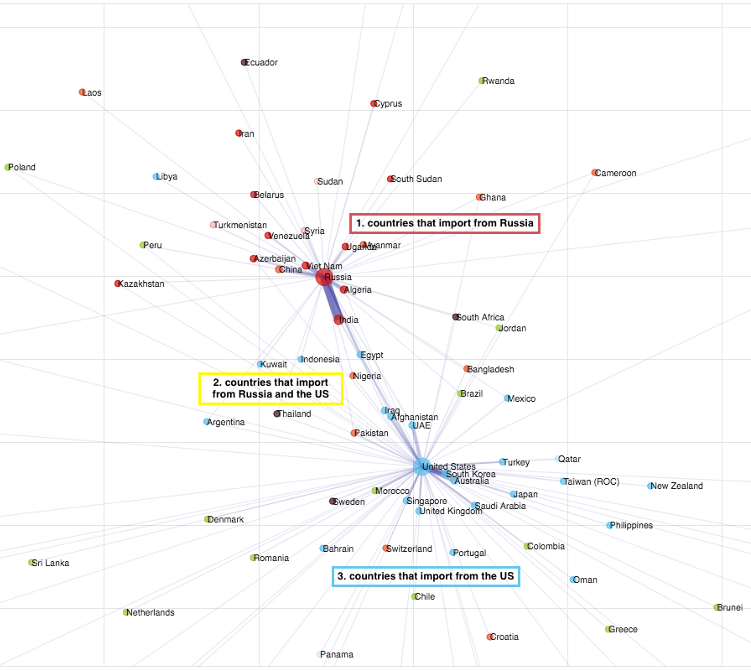
As an example, Singapore imports 71% of its weapons from the United States along with significant amounts from Germany (10%) and Sweden (6%). As such, it is very close to the United States in these visualizations. Meanwhile, India imports 70% of its arms from Russia, with the U.S. (12%) and Israel (7%) as other major partners.
Here’s another look from Hai Nguyen Mau that just focuses on U.S. and Russian relationships:
Article 2(2) includes brokering among the key activities of the international arms trade that are covered by the Treaty’s use of the term “transfer”. Therefore, any provision in the Treaty that refers to “transfer” also covers “brokering”. Critically, to implement Article 5(5), a state party’s national control system must include measures to regulate brokering in conventional arms. As shown in Subsection 3.2, states parties not only use registration and licensing to fulfil this obligation, but also other measures. Article 10 refers explicitly to regulating the brokering of conventional arms under Article 2(1); it does not oblige states parties to regulate brokering of ammunition (covered by Article 3) or of parts and components (covered by Article 4). However, in accordance with Article 6 on prohibitions, a state party must not authorize brokering activities involving conventional arms, ammunition, parts and components if the transfer would violate United Nations Security Council sanctions such as an arms embargo or other relevant international treaty obligations. Further, if the state party has knowledge at the time of authorization that the arms or items covered by the brokering activities would be used in the commission of genocide, crimes against humanity, grave breaches of the 1949 Geneva Conventions or other war crimes, then the brokering activities shall not be authorized and are prohibited. Unsurprisingly, given that brokers could wittingly or inadvertently facilitate diversion, Article 11 contains important provisions for a state party to consider for regulating brokering and preventing illicit arms brokering. Article 11(1) obliges a state party involved in a transfer of conventional arms to take measures to prevent their diversion. This therefore includes the state party in which a broker is located when facilitating, mediating or making a deal for an arms transfer. Furthermore, Article 11(2) requires an exporting state to conduct an assessment of the risk of diversion, which caninclude examining the risk posed by entitiesinvolved in the arms transfer, such as an armsbroker.Article 11(5) specifically encourages the sharing of information among states parties “on illicit activities” including “illicit brokers”. Finally, Article 11(6) encourages states parties to report “to other states parties, through the Secretariat, on measures taken in addressing the diversion of transferred conventional arms”. This is one way of increasing the availability of information on different measures taken to regulate brokering and will support states parties in their implementation of Article 10. Article 12 (on record-keeping) neither obliges nor encourages states parties to keep records of registered brokers or written authorizations for brokering transactions, while Article 13 (on reporting) does not require annual reporting on authorized or actual transfers for which a state party has authorized or denied brokering activities. The case studies in above highlight the challenges for enforcing national regulations on brokering without records and international cooperation – the provisions in Article 14 (on enforcement) and Article 15 (on international cooperation) are thus of particular relevance for the effective implementation of Articles 10 and 11. Given the limited guidance in the Treaty text on regulating brokering, information provided in a states parties’ initial reports serves as an importance source of information to understand the effective measures used by states parties to implement Article 10 and related provisions on brokering, and the challenges that they face in doing so.


Comments
Post a Comment